If it feels like the wasps show up out of nowhere every year and then suddenly seem to be everywhere by the end of summer, you’re not imagining it. Wasp season in North Carolina runs from roughly late March through November, but colonies reach their largest size and their most aggressive behavior in August and September. That late-summer peak is when stings are most likely, and it’s often when a nest that went unnoticed back in spring has quietly grown into a serious problem right next to your back door.
For homeowners across Raleigh and the Greater Triangle, understanding how the season unfolds is the difference between handling a small nest early and dealing with an aggressive colony of thousands at the worst possible time. Here’s what to expect this season, where these stinging insects like to hide, and how to stay ahead of them.
When Is Wasp Season in North Carolina?
Wasp season in North Carolina follows a predictable annual cycle, and knowing the rhythm helps you anticipate trouble before it starts.
It begins in early spring. In March and April, queen wasps emerge from their overwintering spots and start building small new nests from scratch. At this stage a nest is tiny, lightly defended, and easy to deal with, so most people simply never notice them.
Through May and June, colonies expand rapidly. Worker populations grow, nests become visible, and the wasps begin actively defending their territory. This is when you’ll start spotting nests under eaves or hearing more buzzing around the yard.
Then comes the peak. In July, August, and September, colonies reach their maximum size and their maximum aggression. Some yellow jacket nests can hold thousands of workers by late summer. This is the stretch when stings spike and encounters turn unpleasant.
Finally, activity winds down. As temperatures drop in late fall, colonies decline, workers die off, and only newly mated queens survive the winter to start the cycle again the following spring. A mild North Carolina November can keep a few stragglers active longer than expected, but the season is effectively over by the first hard cold.
Why Wasps Get More Aggressive in Late Summer and Early Fall
A lot of homeowners notice that wasps seem downright hostile by the end of summer, and there’s a real biological reason for it. It comes down to food.
Through spring and early summer, wasps feed largely on other insects such as caterpillars, aphids, and similar prey. That keeps them busy and largely away from people. But as summer wears on, those natural food sources get depleted. At the same time, the colony has grown to its largest size of the year, which means more mouths competing for less food.
The result is a lot of hungry wasps foraging aggressively and much closer to human activity. This is exactly why they suddenly turn up at cookouts, on patios, around trash cans, and hovering near hummingbird feeders and sweet drinks in August and September. They’re desperate, they’re numerous, and they’re far more willing to defend themselves and their nest.
It’s worth remembering that unlike honeybees, most wasps and hornets can sting multiple times, and some species release alarm pheromones that recruit nestmates to join an attack. That’s what makes late-season encounters genuinely dangerous, especially for anyone with a sting allergy.
Which Stinging Insects Are Most Active Around the Triangle?
“Wasp” is a broad term, and the species you’re most likely to run into around Raleigh, Durham, and the surrounding communities each behave a little differently.
Yellow jackets are the ones most likely to cause serious harm in North Carolina. They nest in ground voids, wall cavities, and other hidden spaces, and their colonies can swell to thousands of workers by late summer. They sting repeatedly and become especially reactive when a nest is disturbed. Accidentally pushing a lawnmower over a ground nest is a classic and painful example.
Bald-faced hornets are technically a type of yellow jacket, but they build the large, gray, papery aerial nests you’ll see hanging from tree branches and shrubs. They’re extremely defensive of those nests, and they respond to vibration and proximity; sometimes even someone simply walking too close is enough to trigger an attack.
Paper wasps are the more familiar, slender wasps that build open, umbrella-shaped nests under eaves and porch ceilings. Their colonies are much smaller, and they’re generally less aggressive, but they’ll still sting if the nest is touched or a wasp gets trapped against your skin.
European hornets are large and unique for being active at night, when they’re often drawn to outdoor lights and porch fixtures, a startling surprise for homeowners who don’t expect hornets after dark. They tend to nest in hollow trees, wall voids, and attics.
Because the right treatment depends on correctly identifying the species and locating the nest, this is one area where a trained eye makes a real difference. Our flying insects control service is built around exactly that: identifying what you’re dealing with and treating it at the source.
Where Wasps and Hornets Build Nests on Your Property
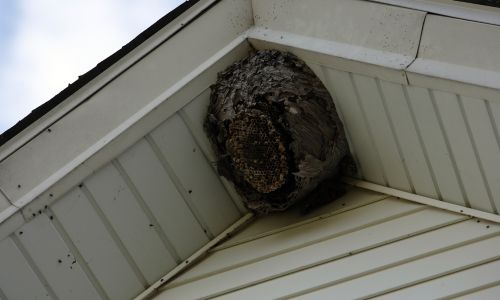
Knowing where these insects like to build makes it far easier to catch a nest while it’s still small. Different species favor different spots. Paper wasps gravitate toward the sheltered, protected areas around your house, such as eaves, porch ceilings, deck railings, window frames, door frames, and even inside grills and outdoor storage sheds. Anywhere with an overhang and a bit of protection from the rain is fair game.
Yellow jackets prefer to stay hidden. They’ll nest in underground burrows, wall voids, and hollow spaces where you can’t easily see them, which is part of what makes them so easy to disturb by accident.
Bald-faced hornets and other aerial nesters hang their distinctive papery nests from tree branches, shrubs, and building overhangs, often high enough that they go unnoticed until the nest is large.
European hornets look for hollow trees, wall voids, and attic spaces, and their attraction to light means you may first notice them around exterior fixtures at night.
A quick walk around your property in spring checking eaves, overhangs, tree branches, and the corners of porches and sheds is one of the simplest and most effective things you can do to prevent a late-summer problem.
What to Do If You Find a Nest (and What Not to Do)
Finding a nest doesn’t have to turn into an emergency, but how you react matters a great deal.
The single most important rule: don’t disturb it. Vibration, swatting, throwing things, or simply getting too close can provoke a defensive swarm, and because wasps can sting many times. Keep children and pets well clear of any active nest until it’s dealt with.
A few specific things to avoid:
- Don’t knock down or block an active nest. Sealing the entrance to a wall-void nest, for example, can drive the colony into your living space as they look for another way out.
- Don’t rely on store-bought sprays for large or hidden nests. DIY treatments often agitate the colony without eliminating it, especially with yellow jackets in the ground or hornets high in a tree. That leaves you with angry wasps and an unresolved nest.
- Don’t treat a nest you can’t safely reach. Ladders plus swarming stinging insects are a bad combination.
Any active nest during the warmer months, especially one near a door, walkway, playground, or seating area, is best left to a professional who can treat it safely and completely.
When Should You Call Carolina’s Best Pest Control?
Some wasp situations you can keep an eye on. Others warrant a call right away. Reach out to a professional if any of the following are true:
- There’s an active nest near a high-traffic part of your home – a doorway, garage, deck, patio, or play area.
- The nest is large, or it’s in a hard-to-reach or hidden location like a wall void or high in a tree.
- You’ve spotted yellow jackets going in and out of a hole in the ground or an exterior wall.
- Anyone in your household is allergic to stings, where even a single sting can become a medical emergency.
- You’ve tried to handle it yourself, and the wasps keep coming back.
At Carolina’s Best Pest Control, we locate the nest and treat it safely with targeted applications rather than broad spraying across your property. We’re veteran-owned, family-operated, and local – you can read more about how we work – and we serve homeowners throughout Raleigh, Durham, Cary, Wendell, and the surrounding Triangle communities. We also handle stinging-insect issues for businesses through our commercial pest management services, from warehouses to multi-family properties.
Wasp season peaks fast, and a nest only gets bigger and more defensive the longer it sits. If stinging insects have taken over your eaves, your yard, or your walls this season, don’t wait for someone to get stung. Request a free quote today, and we’ll get your outdoor space back to being yours.
This article is for general informational purposes. Stinging insects can pose real health risks, particularly to those with allergies — if you’re dealing with an active nest, contact a licensed professional rather than attempting removal yourself.